

Telehandler vs Forklift: Which One Is Right for Your Job Site?
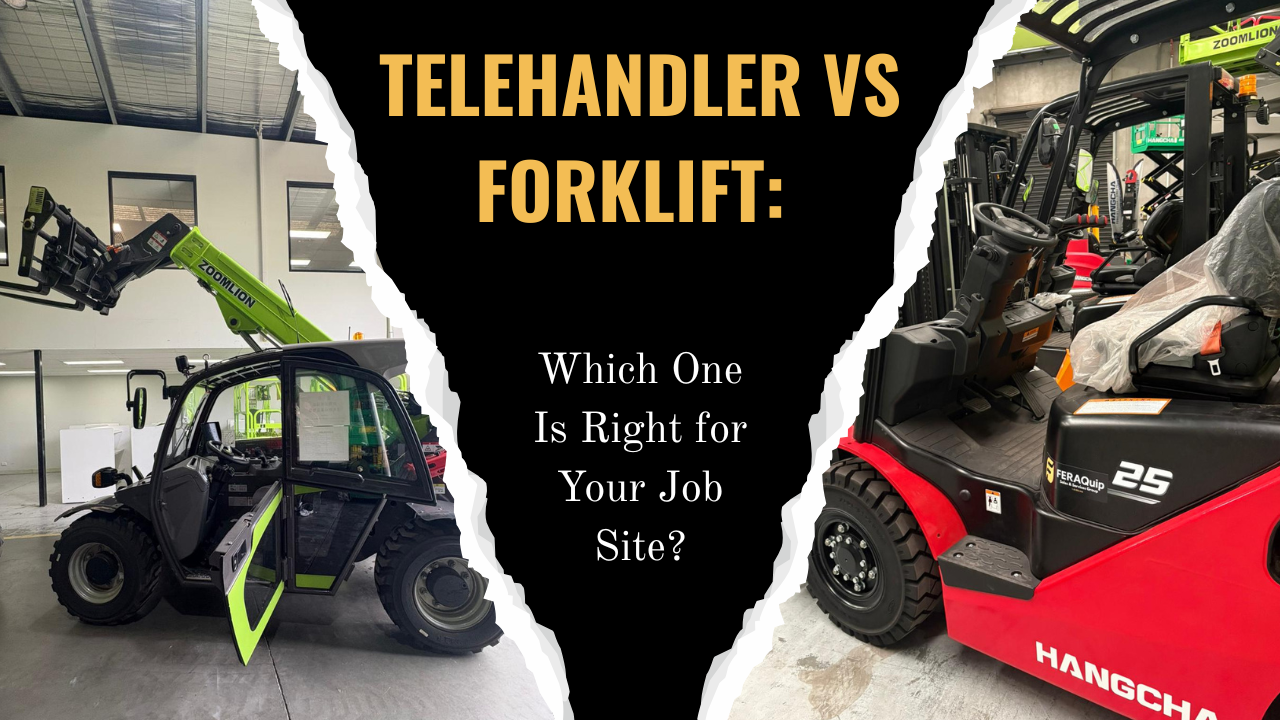
Telehandler vs Forklift: Which One Is Right for Your Job Site?
Telehandler vs Forklift: Which One Is Right for Your Job Site?
When it comes to construction machinery, choosing the right tool is often debated. While there’s no one-size-fits-all answer, several factors can guide your choice. Take telehandlers and forklifts, for instance, the best choice depends on your environment, type of work and budget.
Below, we’ll review the key considerations so that when purchasing equipment, your decision is guided by knowledge, not guesswork.
What is a Telehandler?
A telehandler is a versatile lifting machine equipped with a telescopic arm that extends forward and upward. But what differentiates it from traditional forklifts? The answer lies in its arm, which allows the operator to reach obstacles, either above or around them.Telehandlers are designed to precisely lift, move and place heavy loads to different heights and distances. Their use includes various industries such as construction, assembly, agriculture and mining.
What makes telehandlers so versatile is that their attachments can be changed depending on the functions or tasks to be performed.
Some attachments for telehandlers include:
· Forks
· Buckets
· Jibs
· Work platforms
· Grapples
What is a Forklift?
A forklift (also called a lift truck or fork truck ) is a powered industrial vehicle with two front forks used to lift and move materials over short distances. Its primary function is to pick up palletised loads and transport them. Forklifts are mainly used in warehouses, distribution centers, factories, loading docks and ports and wholesale businesses.
Forklifts are recognised in the industry for the speed and accuracy with which they pick up and place loads repeatedly and continuously. They can also operate on various types of surfaces.
Telehandler vs Forklift, what is the difference?
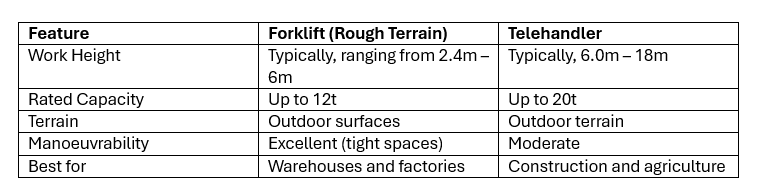
Although both telehandlers and forklifts are designed for lifting, moving and positioning materials, their characteristics allow them to be used for a variety of tasks. Below are some relevant performance data:
Range of heavy machinery
When working at height, telehandlers offer significantly greater reach and versatility compared to forklifts. While forklifts are generally designed for lower stacking and loading tasks, telehandlers are built to handle elevated placements, making them a more suitable choice for projects that require extended vertical access.
Although both machines support similar loads, forklifts maintain their capacity consistently, while with telehandlers, it can decrease when the boom is extended. Likewise, their design and size affect their agility.
While forklifts are compact and work in narrow, confined spaces, such as warehouses, telehandlers are larger and require more space to operate.
Can you Use Both on the Same Job Site?
When it comes to large, mixed-use projects, such as construction sites, internal and external distribution centers and large industrial facilities, telehandlers and forklifts can operate simultaneously. With a well-executed action plan, both machines can be used on the same project.
While the forklift handles internal distribution or warehouse management, the telehandler can move materials outdoors or in hard-to-reach areas. Therefore, acquiring both machines to operate in the same environment wouldn't be unreasonable.
However, to maximise the efficiency of the forklift and telehandler, certain parameters must be defined, such as a traffic plan, operating zones for each machine, signage, hiring certified operators and clearly defining operational areas so that the two machines don't work in the same zone.
FAQ’s
Can I drive a telehandler with a forklift licence?
No. Although a telehandler and a forklift may look similar, they are different pieces of equipment and require specific certifications. It's best to check local regulations and ensure you have the appropriate training.
Can you drive a telehandler on the road?
Yes, but under specific conditions. In most cases, road use is limited to short trips between construction sites or agricultural properties. As requirements can vary by state, it's best to check with the local transport authority.
How much can a telehandler lift?
Lifting capacity varies depending on the model and the industry. Most telehandlers lift between 2.5 and 4 tons. Higher-capacity models can exceed 5 tons.
How much does a telehandler cost?
The price in Australia varies depending on the brand, capacity and condition of the machine and can cost approximately between $90,000 and $200,000 AUD.
At FERAQuip, we offer forklifts with capacities of up to 10 tonnes and telehandlers up to 4 tonnes. We also provide flexible financing options. If you have any questions, our team will be happy to assist you and help you choose the right equipment for your workplace. Contact us today.
